Research
Better Maryland Schools believes school policy should reflect reliable research, not opinion. For parents, citizens, and journalists who want to dig into the evidence, we’ve provided citations below. These sources include peer reviewed journals, books that cite established research, and news articles that provide context. Whenever possible, we prioritize original data and peer-reviewed research.
Reading
Structured literacy (often called scientifically based reading instruction) helps everyone. Balanced literacy and whole language do not produce as many competent readers.
national reading panel report -- evidence supporting all five components of reading instructionWhole language high jinks -- Comprehensive comparison of methodsHow words cast their spell -- Spelling is not about memorization, it's about understanding english's 4 layersfrom speech to print -- The book every teacher needs to learn what most were never taughtlanguage at the speed of sight — How We Read, Why So Many Can't, and What Can Be Done About ItThe roots of phonics — the classic book that explains how english worksreading in the brain — the new science of how we readEssentials of Assessing, Preventing, and Overcoming Reading Difficulties -- highly technical resource, includes curriculum evaluations
Math
The highest achieving nations in math focus on a smaller number of topics, taught to mastery.
singapore math -- how it helps kids learnNational council on teacher quality — report on teachers' math preparationteaching and knowing elementary mathematics — the classic, groundbreaking bookthe number sense — how the mind creates mathtraditional math — an effective strategy that teachers feel guilty using
Instruction
Traditional methods produce better results than so-called “student centered” methods, especially for lower income children.
the academic achievement challenge: what really works in the classroom -- From the harvard professor who helped create sesame streetthe schools we need and why we don't have them -- from the university of virginia professor who started core knowledgemyths and misconceptions about teaching: what really happens in the classroom -- an education professor dispells beliefs most educators believewhen can you trust the experts? — a cognitive scientist explains how the brain really worksdirect instruction — one of the largest studies ever conducted found direct instruction produces the best results
Academic Results
America does not perform well on the world stage. Maryland compares poorly to other states. (These are fair comparisons where all children are tested, not just the smartest or richest children.)
timms results -- math & science international comparisonpisa results -- math, science & reading international comparisonNAEP Results -- Math & reading, Maryland is below averageSAT results — maryland is below average (1003 compared to u.s. average of 1024). Frederick got 1012, also below average.MATH — 69% of frederick county’s students fail algebra, with disappointing results in math in all gradesScience — less than half of frederick county’s students are proficientEnglish — even poor reading instruction results in about 60% passing ratE (See Page 11). Our scores barely exceed that baseline.
Class Sizes
Lowering class sizes across the board does not appear to raise achievement. But there are exceptions.
Brookings report -- minimal effects at a high costcampbell study — found negative impact on math, small impact overall
School Choice
Charter schools tend to raise achievement.
stanford credo studies -- comprehensive longitudinal reviews (considered the gold standard)fordham foundation — charters tend to improve the regular public schoolsNational Alliance ranking (Last) & EdReform ranking (bottom 5) — maryland’s charter law consistently ranks among the worst nationallycharter schools and their enemies — who opposes them, and why
Gender Dysphoria
Most, but not all, students experiencing gender dysphoria will grow comfortable with their biological sex after completing puberty. Mainstream research urges psychological and family support, and caution for minors considering gender transitions.
RECENT STUDY -- having gender concerns can be a part of student devleopment, but most kids grow comfortable with their biological sexHistorical trends — dr. James cantor FACT checks over 40 years of evidence, which shows most minors do not identify as transgender as adultsdr. erica anderson (who is transgender) and dr. Steven Levin — Expert witness testimony accepted by courtscass review — four year study finds “remarkably weak” evidence for minors having gender transitionsreconsidering the "dutch protocol" — written by the same scientists who originally supported gender transitions for minors, who now express doubts
Unions
Unions are involved in politics to a greater degree than many realize—including issues outside of education—and they mostly donate to one party.
union plans to smear opponents -- see the their plans & playbook herehoover institution (stanford) -- Unions win 70% of board of education electionsThe 74 Million — unions largely donate to one partyProfessional liability insurance — teachers can get twice the coverage for half the cost from non-union providersamericans for fair treatment — the supreme court ruled that teachers are not required to join a unionNEa’s controversial resolutions — many are political and unrelated to education
Disciplinary Practices
Whether practices such as “restorative discipline” are effective is a matter of debate. These practices encouraged but not mandated by Maryland law.
our policy recommendations -- this includes a discussion of the legal history and research evidencerand study reconsidered -- have the postive results of restorative practices been reported fairly?are restorative practice ethical? — these scholars think they are notBad therapy — an examination of whether the modern emphasis on therapy has backfired for todays’ students
Spending
Across-the-board spending increases show weak/mixed relationships with achievement; targeted spending changes and finance reforms show more consistent positive long-run effects—especially for low-income students.
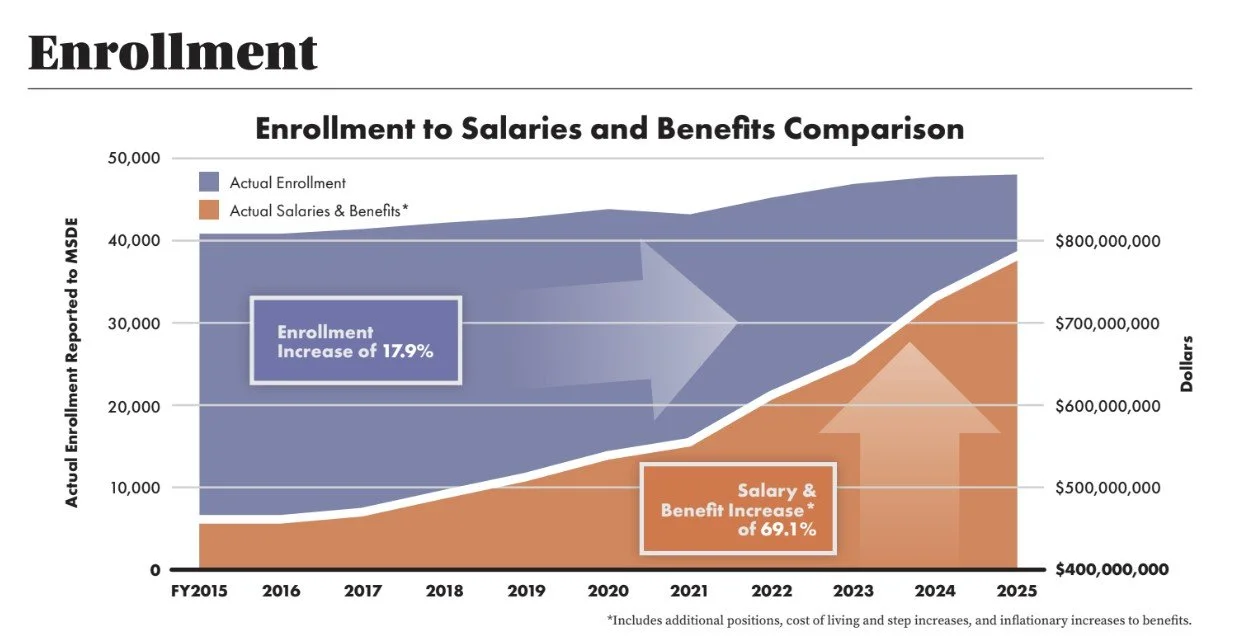
spending vs. achievement chart -- more money is not associated with higher achievementNCES review — suggests that allocations (rather than total amount) may matter moregraphs of 25 Years of FCPS budgets -- our analysisOfficial FCPS Budget booksFCPS’ official graphic showing staff costs growing 3.8 times faster than enrollment (In 2027 Budget announcement)
Want official information from FCPS?
We regularly request public information available under the Maryland Public Information Act to monitor how programs and policies work in practice. Click here to see some of the interesting information available.